Dysomnia Heredity Rule
Broken Rejected MateDysomnia Heredity Rule defines Dysomnia as a hereditary condition rather than an acquired one, while refusing to make inheritance predictable. A Dysomnia may appear in a bloodline, skip several generations, or never emerge again, making ancestry a source of both fear and uncertainty. The rule connects private family history to collective survival: it explains why Sierra Langford is treated as a dangerous descendant, why so few Dysomnias remain, and why her possible children carry implications beyond the household.
Definition and Inheritance Pattern
Dysomnia is described as hereditary, but its transmission does not follow a simple uninterrupted line. Sierra Langford knows that the trait can skip generations or fail to appear again in a family, so blood relation alone cannot guarantee that a descendant will become Dysomnia. This instability makes the bloodline difficult to predict and prevents the surviving community from treating heredity as a straightforward succession system.
The rule also distinguishes Dysomnias from ordinary wolves through inherited capacity. Sierra understands that Dysomnias possess greater power and more magic than normal wolves, but the appearance of those qualities is not controlled by choice or training. Her first confirmed connection with her wolf is presented as an exceptional hereditary development: her wolf tells her that she is the first Dysomnia in a hundred years to achieve such a connection, reinforcing both the rarity of the bloodline and the uneven way its abilities manifest.
Family History and Persecution
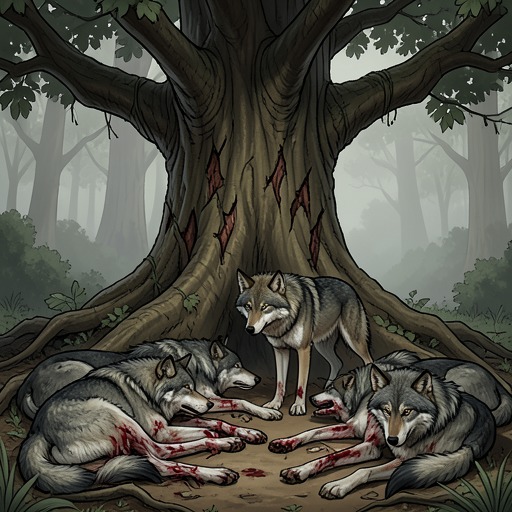
Sierra’s account of her mother gives the rule its most personal history. Her mother was recognized as unusual from birth, and members of her pack wanted her killed. Her father’s position as Alpha protected her temporarily, allowing the family to wait until her first shift. She later won the affection of the pack, but that acceptance proved conditional: after her first shift, during which she killed two pack members, the pack turned against her, including her own father.
Pregnancy temporarily restrained the pack’s violence. Once the family discovered that Sierra’s mother was carrying a child, they delayed the killing because killing a pregnant werewolf would be sacrilege. That protection ended immediately after Sierra was born. Her mother was taken away and killed, while her father fled with the newborn Sierra and spent her childhood living on the run. Her existence therefore preserves the bloodline while also exposing the lethal social consequences attached to it.
Scarcity and Survival
The rule becomes even more consequential when Sierra learns that only three Dysomnias exist in the present world: herself and two others. Their rarity is not simply the result of hereditary skipping. It is also connected to the destruction of Dysomnia history books and the widespread fear of the group. The surviving bloodline has been weakened by persecution, ignorance, and the loss of knowledge needed to understand its abilities.
Sierra’s achievement does not heal the entire population. Her wolf makes clear that the other two Dysomnias must face journeys as harsh and painful as hers, and that they may or may not reach the level of connection Sierra has attained. Her desire to help them is met with the practical warning that she may never meet them and must first keep the promise made to her father to survive. Her individual breakthrough is therefore significant but not automatically transferable; heredity creates potential, not guaranteed recovery or shared mastery.
Bloodline and Pack Power
Dysomnia heredity exists alongside the separate inheritance of Alpha blood, and the two systems converge in the question of leadership. Alan Lowell, Anthony Lowell, and Andrew Lowell share a future in which they are expected to fight to determine who becomes Alpha. Their closeness does not erase competition, because bloodline and succession turn family intimacy into a political contest.
The Blue Blood Pack’s later leadership crisis shows how inherited status functions institutionally. After the previous Alpha’s absence, the pack asks Alana Lowell whether she will govern temporarily, but she declines and states that Anthony Lowell has no desire to become the next Alpha. The pack then turns to the only other wolf present with Alpha blood, Alan Lowell. His eligibility rests partly on inherited lineage, even though the elders also judge him by demonstrated qualities such as strength, courage, mercy, and fairness. Heredity opens the door to authority, while conduct determines whether that authority can be accepted.
Alan’s family history also gives inherited status an emotional burden. He fears that Anthony Lowell and Andrew Lowell may have inherited not only the good qualities of their father but also the darker ones. The possibility of moral traits passing alongside bloodline makes heredity more than a biological mechanism: it becomes a source of suspicion, loyalty, rivalry, and self-protection within the family.
Future Generations and Significance
The rule remains active at the end of the story rather than belonging only to Sierra’s origin. Sierra Langford and Alan Lowell have been nervous about having a child because they do not know how to handle a Dysomnian child born with Alpha blood. Their decision to try for a baby places two powerful inheritances in the same future family, joining the unstable Dysomnia bloodline to the Blue Blood Pack’s leadership lineage.
That decision transforms heredity from a sentence imposed by earlier generations into a responsibility consciously faced by the next one. Sierra was born into a bloodline that caused her mother’s persecution and death; she and Alan instead approach the possibility of a child together, believing they can raise that child despite the dangers. The rule thus carries an unresolved tension: inheritance can reproduce fear and violence, but it can also become the basis for protection, knowledge, and a new family structure.